Practice / Modeling a person
Our users do not arrive in their best state
I’ve learned a great deal from psychology that product and design teams can use. The most useful part so far is that people move between states, while our words for them describe traits.
It started with a movie#
It started when I watched Inside Out with my sisters. Since then I’ve gone down the serious deep end with a therapeutic model called Internal Family Systems, or IFS.
The more I’ve researched, the more certain I’ve become that this is gold for everyone building products.
The mistake underneath the word user#
Every time we write user, or persona, or customer, we’re writing a definition of a person. Underneath that definition is usually a list of traits: what they want, how they behave, what they value, all of them assumed to be steady.
The problem is that a trait is something a person possesses, while a state is something a person is in. Being short of time, being new and being frightened of getting it wrong are all states. None of those say anything about who the user actually is.
Everybody has a full crew#
The IFS model views the mind as a natural system of sub-personalities, or parts. Essentially it says we each have a full crew in our minds. The crew arrived over time, with only one of them in the driver’s seat at any given moment.
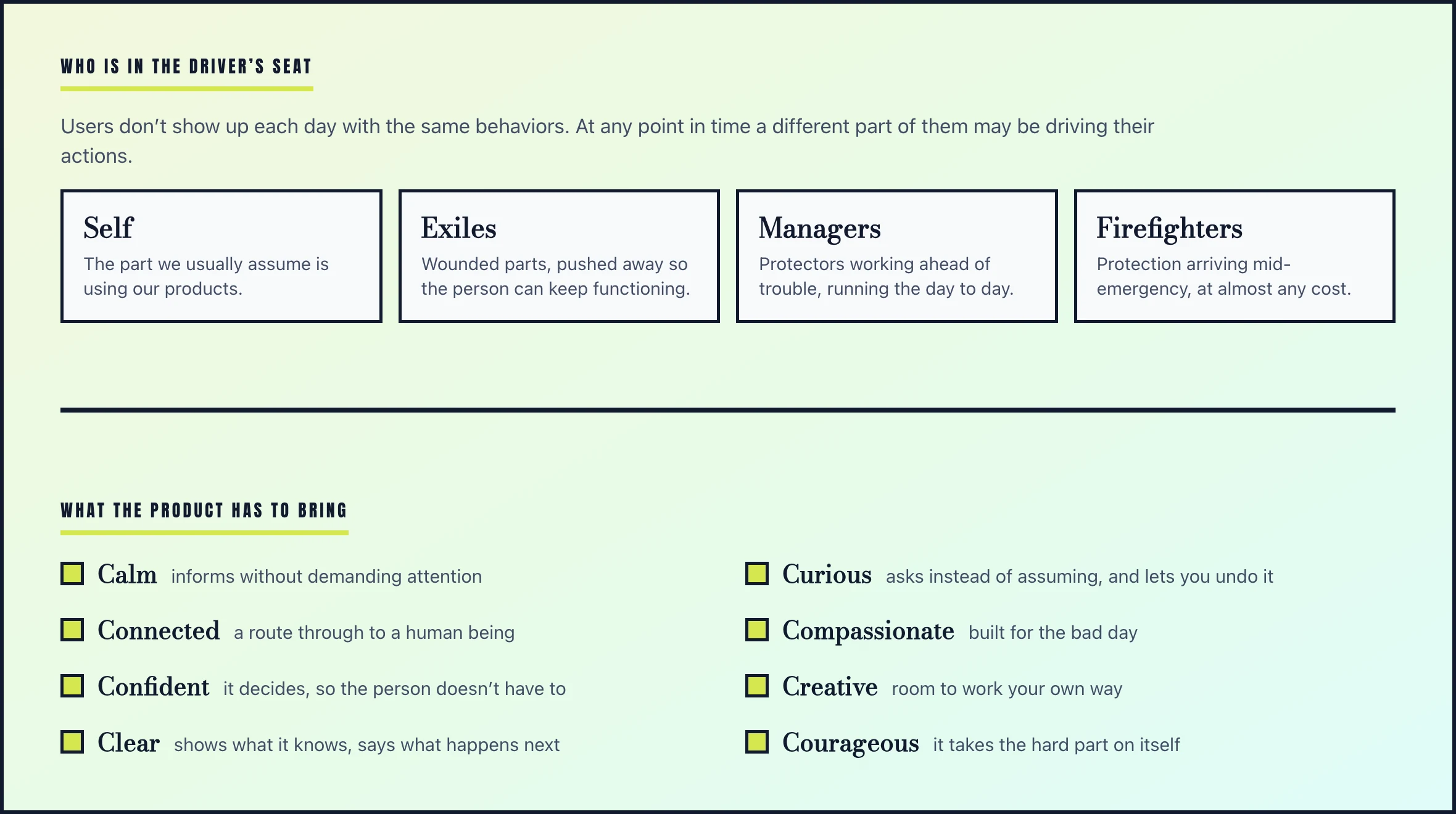
The crew is made up of four kinds of part.
- Self, the part we usually assume is using our products
- Exiles
- Managers
- Firefighters
Which part is driving when they reach us#
For product and design teams the consequence is immediate. It means asking what situation somebody is arriving in, and which of their parts is driving when they reach us.
The crew also changes hands. A different crew member can and will take the console at any moment and drive from there.
Modeling our users as being in a consistent state is an expensive mistake, because the same user doesn’t show up each day with the same behaviors.
The eight C’s describe somebody at their best#
The IFS model also defines Self as having eight qualities, the eight C’s: calm, curious, connected, compassionate, confident, creative, clear and courageous.
The eight C’s describe the person every team designs for, and the person a persona usually describes. They are rested, unhurried, reading the screen properly and having a decent week.
The people who actually use our products are more often being driven by one of three other kinds of part.
- Exiles: vulnerable, wounded parts holding painful memories and shame, pushed away so the person can keep functioning
- Managers: protectors that work ahead of trouble, running the day to day so an exile never gets hurt again
- Firefighters: protection that arrives mid-emergency and will do almost anything to put out extreme pain, including things that cause harm
Put the eight C’s in the product instead#
So what can we do about this? We can’t require or assume that a person arrives as their most resourced self.
A product that only works for the calm, clear version of our users is a product that will fail.
We can put the eight C’s in the product instead. If our users are being driven by an exile, a manager or a firefighter, the calm has to come from our screen.
- Calm: it informs without demanding attention
- Curious: it asks instead of assuming, and it lets somebody try a thing and undo it
- Connected: there is a route through to a human being
- Compassionate: it is built for the bad day rather than the good one
- Confident: it decides, so the person doesn’t have to
- Creative: it leaves room for somebody to work their own way
- Clear: it shows what it already knows and says what happens next
- Courageous: it takes the hard part on itself